Tag: sci-fi

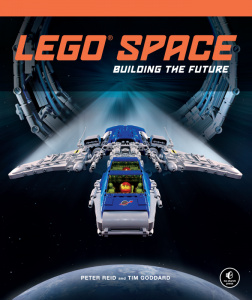
  • Lego Space: Building the Future by Peter Reid (No Starch Press)

    Lego Space Cover

    When I was a kid, two of my favourite things were my Space Lego and a book by Stewart Crowley, Spacecraft 2000 to 2100AD. Crowley’s book was notable mainly for its assortment of amazing early 1970s science fiction book cover illustrations that were repurposed/licensed to accompany Crowley’s history of the Terran Trade Authority and its space war with Alpha and Proxima Centauri. Covering different spacecraft – complete with engineering specifications – that were used to trade with and later battle, the book was the sort of thing that could quickly provide a backstory to a Space Lego build.

    But now there’s this – Peter Reid’s Lego Space: Building the Future.

    Peter Reid’s book reminds me a lot of Crowley’s, and it is done in Lego. Reid is one of those amazing ‘adult fans of Lego’ who has built an entire alternative universe of space themed Lego models and dioramas out of primarily first generation, late 70s Space Lego and the late 80s Blacktron Space Lego parts. Reid’s models are utterly amazing and show what is possible with Lego. Whilst building instructions are provided for a few of the smaller models you will probably have difficulty some of the necessary pieces, especially the all-black pieces. (I’m excited that his Exo Suit, featured in the book, made it through the Cusoo process and will be commercially available in 2014)

    Reid’s storyline follows humankind’s exploration of space from Sputnik and the Moon landing, through to first alien contact on Jupiter’s moon Ganymede. Its quite a good story for a 6 to 10 year old, far better than any of the stories in those terrible ‘official’ Lego stories (avoid the Ninjago ones like the plague!). There’s also enough filmic references, to make you, as a parent, want to sit your kids down and watch Aliens, Dark Star, 2001, and the classics. And a bonus point for the Lovecraftian allusions to the vast unknowable terrors of the universe when Admiral Kazak first brain-melds with the worm discovered in the ice. Double bonus points for including female minifigs and characters in the story – especially given the (continuing) general dearth of them in the Lego portfolio (let’s not talk about Lego Friends).

    Highly recommended.

    Some of Reid’s Lego models in his Flickr stream.

    Seb Chan
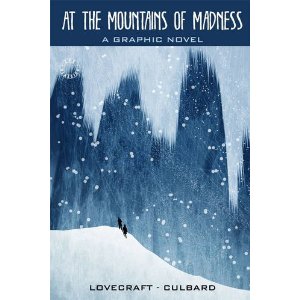
  • At The Mountains of Madness: A Graphic Novel – HP Lovecraft & INJ Culbard (Self Made Hero Press)

    I was in lower secondary school when I came across HP Lovecraft and I remember raiding the local public library for several months, trying to read every possible story and associated work. They weren’t popular titles at the library and I got onto other writers like Ambrose Bierce and August Derleth as I went on. Pulp was good for the teenage imagination – and the historical atmospheres had far more resonance with me than a lot of contemporary pulp of the 80s.

    It wasn’t until many years later in the mid 1990s that I realised that I wasn’t alone in my interest in Lovecraft – and as it turned out the whole Cthulhu mythos is deeply ingrained in much of nerd culture.

    As part of Self Made Hero’s series of INJ Culbard’s re-visioning of genre classics (notably several Sherlock Holmes titles), comes one of my favourite Lovecraft stories – At The Mountains Of Madness.

    Set in Antarctica in 1930, a group of explorers discover remnants of an ancient civilisation beyond the ice . . . It is a great short story and in graphic novel form it works particularly well, simultaneously prizing open the difficulties of the archaic-ness of much of Lovecraft’s writing style, and emphasising the pace and oddness of the original. The way in which the story unfolds graphically is done beautifully with fantastic angles and frames whilst also paying homage to Tintin’s classic adventure comic visual style.

    This isn’t one for small children – but for younger teens it is a great introduction to one of the more interesting pulp writers of the early 20th century whose alternative universes are well worth exploration, especially for those with an interest in speculative science. The graphic novel form is a much easier proposition that Lovecraft’s dense text and should whet the appetite for the other stories related to the Cthulhu mythos.

    You can buy direct from Self Made Hero Press.

    Bonus: the original short story was the basis of one of my favourite 1980s horror films – John Carpenter’s version of The Thing (1982). I even did a live remix of the soundtrack at the club night I used to run in Sydney. Carpenter’s film was billed as a remake of the 50s classic The Thing, but in many ways it is truer to Lovecraft’s short story combining it with elements of Alien.