Tag: illustrated

  • The Fantastic Flying Books of Morris Lessmore by William Joyce (Moonbot Studios)

    Hey, what’s this? An iPad App in a blog about children’s books?

    Sacrilege?!

    No, in fact The Fantastic Flying Books of Morris Lessmore is the kind of e-book both my kids and I had been waiting for. What’s more (and somewhat ironically) it itself is an ode to the pleasure of books.

    We’ve had a number of the ‘interactive books’ in the house since the iPad set foot in our abode. First the Dr Seuss titles from Oceanmedia – really just early readers with a ‘read-it-to-me’ mode. Then those interactive ‘reference titles’ like the Solar System.

    But none, until now, have really started to show the potential of the medium in terms of storytelling. No doubt Lessmore’s richness is a result of its parallel life as a short film, and the talents of Pixar-quality illustration and animation (Joyce used to do character design for Pixar). But the first thing that struck me about this title was that the interactive elements were so well integrated into the story itself. Whereas other titles intersperse a classic story with an interactive scene (Alice in Wonderland being the first example of this), every scene in Morris Lessmore is ‘interactive’ – but not to the point where it takes over from the story itself.

    Apart from the illustrations, animation and interactivity, what matters most is that it’s a worthwhile story too – a man who gets lost in books – with the same wistful quality that Pixar’s Up did.

    Being a well designed App, the sound effects, music and voiceovers can all be toggled as well as the text itself – so you can go completely ‘book-like’ or completely ‘film-like’ depending on your preferences.

    At US$4.99 The Fantastic Flying Books of Morris Lessmore is a complete bargain – you’d be paying $20 if it was a hardcover picture book. And it’d be half as fun. Highly recommended.
  • Ramayana: Divine Loophole by Sanjay Patel

    I’ve never read the Ramayana nor really delved deep into Indian mythos. Brought up on the Greco-Roman and Chinese pantheons, the only other mythos I really explored intently as a child were Egyptian (no child can really resist pyramids?) and Norse (Thor! Loki!).

    However tonight I read my youngest the first half of Sanjay Patel’s seriously abridged Ramayana (24,000 verses condensed to 107 pages!).

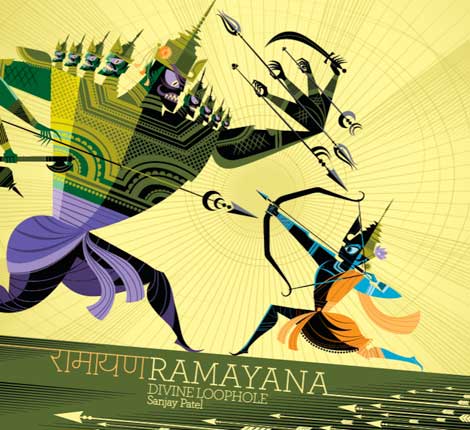
    Patel is probably best known to those in the illustration and design world as one of the Pixar animation team. And here in Ramayana: Divine Loophole he tells the general story through vibrant illustration and some not-quite-so-vibrant text.

    I really can’t fault the digital illustrations. They are stunning and stylised to capture immediate attention – indeed, they reminded me most of the style of The Incredibles – one of the Pixar titles on which Patel worked. The demons are menacing and fierce without being terrifying, and the colour palette is completely saturated, vibrant. The heroes bright and bold. (Check out Patel’s site Ghee Happy for some spreads from the book.)

    The text, for the most part, is functional. But there are some clunkers. I’m not a fan of unnecessary colloquialisms like this – “But [Soorpanaka] was love struck, so much so that she transformed herself into a beautiful maiden and tried making a pass at the blue prince by showing off some of her dance moves”. They end up cheapening the story. Fortunately there aren’t too many instances of these.

    Slightly problematic, at times, too is the contrast on the text. With almost edge to edge illustrations there are a quite a few pages where the small point text vanishes. The worst offenders being the pages with pale yellow text on an orange background (ugh!). I almost unintentionally skipped those paragraphs!

    The final third of the volume, after the main story, is a collection of key characters, gods and demons; a map of the story locations; and several pages of process sketches.

  • The Magic Tree by Gerald McDermott

    Gerald McDermott’s The Magic Tree is a not a tale with a happy ending – indeed the final pages are deliciously ambiguous.

    First told as an animated short film in 1970 and then published in book form in 1973, The Magic Tree is apparently adapted from a traditional Congolese folktale. It tells the story of two brothers, one favoured by their mother, Luemba, and the other ‘ugly’ and cast aside, Mavungu. Mavunga leaves his family home and travels down the river to where he finds a tree and frees a beautiful princess from its magic spell.

    Mavungu is transformed and a village springs up around he and the princess. Eventually Mavungu’s family hears of his fortune and travels to visit him. Mavungu feels the pull of the family home but is reminded by the princess that he has promised never to speak of the magic tree and its spell. His family leaves but Mavungu decides later to pay his despicable mother another visit and he cannot hold his tongue – all is revealed. Mavungu flees only to find that everything is gone.

    The story’s end – told entirely without words – is jarring in a way that opens up the narrative for discussion. What happens now to Mavungu? Why was his mother so wicked? Why is this so unfair? Although these are unpleasant questions, you can almost see them playing out in the little listeners minds.

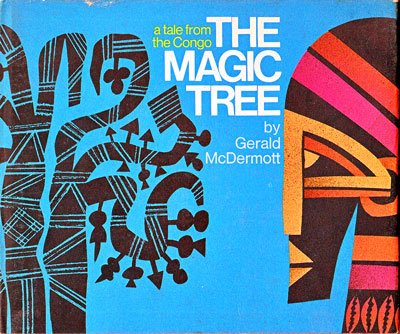
    Beautifully illustrated with an almost wood-cut feel and with great use of dark blues and orange tones, the story’s atmosphere carries well. Also, I think that this book must of have been my first mass exposure to Helvetica as a child. The contrast between the jerky lines of the illustrations and the straight functionalism of the type is lovely too.

    I’d be keen to see the short animation the story was evolved from. McDermott has some of his other animations from the period freely available via the Academic Film Archive and the Internet Archive.

  • Vunce Upon A Time by Siobhan Vivian and J. Otto Seibold

    A Halloween story illustrated by J.Otto Seibold was almost certain to be a winner. Seibold is probably best known for the slightly demented digital illustrations and his Mr Lunch series. You might also know his work from Olive.

    I picked this one up at the Giant Robot store in San Francisco after a surprisingly short stop at Amoeba Records.

    In Vunce Upon A Time a vegetarian vampire called Dagmar finds his secret supplies of lollies have run out. Despairing, one of his friends, a skeleton, tells him of a human tradition called Halloween where lollies are in plentiful supply. Although the prose is rather clunky, and the story convoluted – far too little is made of Dagmar’s vegetarianism – Seibold’s garish and colourful illustrations carry the attention and interest of the young ones. There’s a fantastic double page spread where Dagmar soars high above the town on Halloween night – revealing a town swarming with a cornucopia of costumed beasts which makes for a good bit of ‘spotto’. And, in fact, the assorted lollies on the inside flap always end up being “shared” between us, the readers.

  • Yellow Yellow by Frank Asch

    Being a hoarder I managed to keep several boxes of children’s books from my own childhood. They’ve moved house with me and I’ve been paring them down slowly.

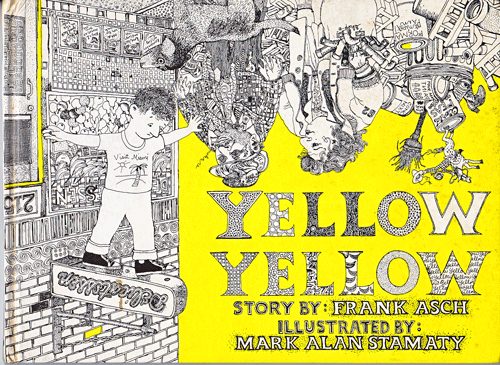
    One of the first to be retrieved from the boxes upon the arrival of child #1 was Yellow Yellow. Dating from 1971 (although the edition I have is from 1973) and one of the earler books from Frank Asch, Yellow Yellow is the story of a boy who finds a yellow workman’s hat which changes his life. The real action for small children, of course, takes place in the illustrations from Mark Alan Stamaty – one of his first contributions to children’s books it seems.

    Each page is full of intricate details, quirks, MC Escher-isms and visual jokes that make repeat readings particularly enjoyable. The illustrations also have a suitably psychedelic quality to them which always elicits puzzled questions like “why does that chicken have a two bodies but only one face?” and “that man has his head on backwards doesn’t he?”.

    There’s a great moment midway through where the boy finds the owner of his yellow hat – one of those rare moments where the physicality of the book as an object becomes apparent and important.

    Neither Asch’s or Stamaty’s websites really mention the book at all – although it does seem to be outlandishly priced second-hand on Amazon.

    But if you see it in a used bookstore snap it up. I’ll definitely be passing my copy on to the next generation.

  • Iggy Peck, Architect by Andrea Beaty & David Roberts

    Iggy Peck, Architect

    Iggy Peck, Architect is a charming rhyming story of a young fellow who loves to build buildings from whatever he has nearby – nappies, chalk, peaches, apples, pancakes, coconut pie – the list goes on. Until, that is, he meets his Grade Two teacher, Miss Lila Greer. She’s been scarred from an early childhood experience involving a skyscraper a lift and a French circus troupe.

    The rhyming couplets that carry the story have a lovely rhythm and Beaty’s book has captured the imagination of both children enough to have clocked up many reads – quite a few repeat reads in the one night too! The illustrations by Roberts are great and the constructions built by Iggy Peck are splendid, and like the best illustrated books there are a few little hidden touches for young eyes to find.

    I picked this book up at the SFMOMA bookshop on a visit to San Francisco but it is available quite widely including on Amazon.

    Any book that excites children to consider architecture and building that doesn’t default to Bob the Builder is a welcome addition to the library!