Tag: 5 and up

  • Albertus Seba – Cabinet of Natural Curiosities (Tashchen)

    cover_ju_25_seba_curiosities_1107131700_id_250489

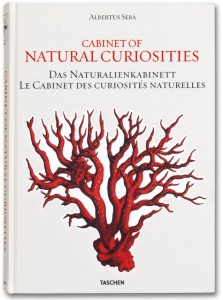
    It is probably the height of aspirational middle class parenting to buy your five year old a Taschen hardcover tome but hear me out.

    Albertus Seba was an pharmacist and collector of specimens from around the globe in the early 1700s. Based in Amsterdam he amassed such an incredible collection both in breadth and depth, reknowned throughout Europe, that he commissioned artists of the time to draw illustrations of his specimens. This lead to the publication of a four volume ‘thesuarus’ of the natural world between 1734 and 1765 delayed by his death in 1735.

    Art publisher Taschen has produced this fantastic set as a single book based on a hand-coloured original with about 400 plates. The detail and diversity is amazing and my son was immediately captivated by its intricacy and strange accumulation of snakes, frogs, lizards, plants, squid, shells, insects, spiders, and butterflies.

    Excited flicking through the pages, “what is that?”, “is that really a . . ?”, “is that real?”.

    Unlike modern ‘references’ books of the natural world – littered with saturated photography and didactic text – there is an immediate sense of ‘wonder’ that pops out from Seba’s arrangements and the intricately detailed hand drawn illustrations. Much like the ‘specimen drawers’ in natural history museums that are making a comeback, there is a certain type of inspiration that comes from seeing ‘everything at once’.

    It is a lovely book and one that more children should be allowed to get their hands on.
  • Ramayana: Divine Loophole by Sanjay Patel

    I’ve never read the Ramayana nor really delved deep into Indian mythos. Brought up on the Greco-Roman and Chinese pantheons, the only other mythos I really explored intently as a child were Egyptian (no child can really resist pyramids?) and Norse (Thor! Loki!).

    However tonight I read my youngest the first half of Sanjay Patel’s seriously abridged Ramayana (24,000 verses condensed to 107 pages!).

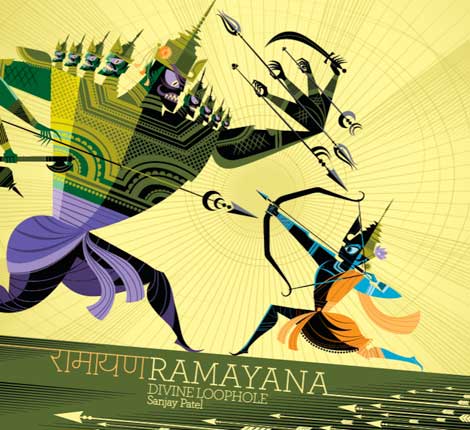
    Patel is probably best known to those in the illustration and design world as one of the Pixar animation team. And here in Ramayana: Divine Loophole he tells the general story through vibrant illustration and some not-quite-so-vibrant text.

    I really can’t fault the digital illustrations. They are stunning and stylised to capture immediate attention – indeed, they reminded me most of the style of The Incredibles – one of the Pixar titles on which Patel worked. The demons are menacing and fierce without being terrifying, and the colour palette is completely saturated, vibrant. The heroes bright and bold. (Check out Patel’s site Ghee Happy for some spreads from the book.)

    The text, for the most part, is functional. But there are some clunkers. I’m not a fan of unnecessary colloquialisms like this – “But [Soorpanaka] was love struck, so much so that she transformed herself into a beautiful maiden and tried making a pass at the blue prince by showing off some of her dance moves”. They end up cheapening the story. Fortunately there aren’t too many instances of these.

    Slightly problematic, at times, too is the contrast on the text. With almost edge to edge illustrations there are a quite a few pages where the small point text vanishes. The worst offenders being the pages with pale yellow text on an orange background (ugh!). I almost unintentionally skipped those paragraphs!

    The final third of the volume, after the main story, is a collection of key characters, gods and demons; a map of the story locations; and several pages of process sketches.

  • A Book of Ghosts & Goblins collected by Ruth Manning-Sanders

    I’m not quite sure when it is ‘appropriate’ to introduce ghost stories to children but I reckon if there are tooth fairies who exchange money for enamel and calcium, and trolls that might leave treats under the bed, then there must also be less savoury magical creatures too.

    In the late 60s and early 70s Ruth Manning-Sanders published a great series of fairy tales from around the world in volumes organised by the creatures present. This one, A Book of Ghosts & Goblins, is one of the best in the series with some quite scary short stories for children.

    I was reading the short Spanish story The Ring to my 6 year old and it brought back vivid memories of hearing it the first time as a child myself. A man finds a ring on an unearthed skeleton in a disturbed graveyard and gives it as a present to his wife. Then that night the ring’s owner comes back to claim it . . .

    There’s some great Estonian stories of nasty goblins as well as some enjoyable African and Siberian contributions too.

    Try to find a copy in your local public library.

  • A Book of Naughty Children by Enid Blyton

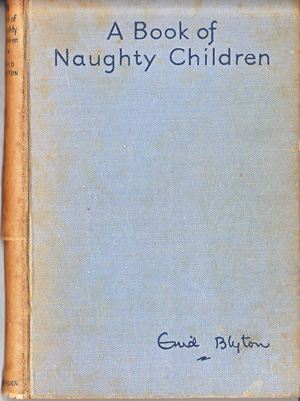
    This book used to be my mum’s. She got it at “Christmas 1946 from Auntie Nellie”. Published during World War 2, I’m pleased to report that inside it has a little insignia stating – “This book is produced in complete conformity with the authorized economy standards”. It has stood up pretty well considering that, just a couple of frays on the spine, and a bit of dusty mould.

    I remember studiously reading several Blyton series as a child – Wishing Chair, Magic Faraway Tree, and, of course the 21 odd volumes of the Famous Five (In fact I vividly remember watching the late 70s TV series after school and was excited to find much of it on YouTube recently). No doubt my mum read me this when I was small, too. For all the criticism of Blyton’s stories – and there’s been a lot of it over the years – this collection of very short stories is great reading in these modern times.

    It is full of all the things ‘we’ don’t do now – whacking the kids when they misbehave, letting them run wild on the streets and the like. Whilst parenting styles have changed for many in the West nowadays, I quite enjoying reminding my children that things weren’t always like that. The look of horror on their little faces is always priceless.

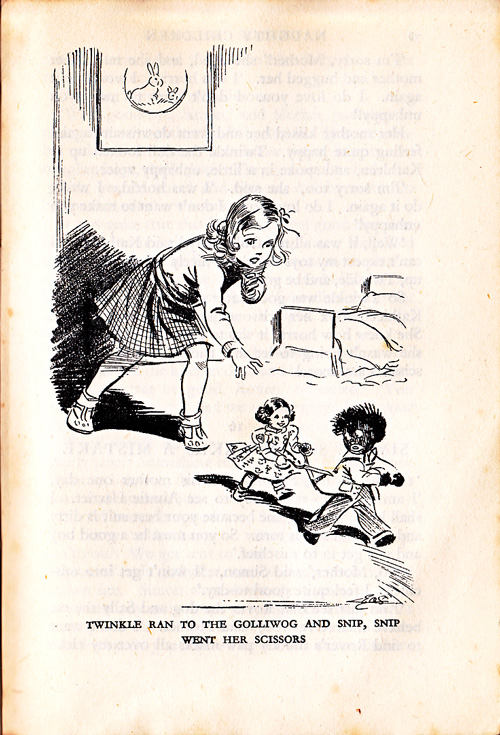
    There are of course, gollywogs, which need a little more contextual explanation.

  • The Heart and the Bottle by Oliver Jeffers

    On Friday night I was wandering up through Newtown before a friend’s art event and stopped in at our local bookshop – you know, one where the staff actually know about the books they sell, and write little ‘reviews’ on the ‘staff picks’.

    And there it was in the children’s section – the new Oliver Jeffers’ book, The Heart and the Bottle. Given the enthusiasm we’ve had for Lost & Found (which I’ll write about later), I picked it up without much hesitation.

    In short, the narrative revolves around a girl who is fascinated with the world around her before she finds (her Dad’s) chair empty one day. She puts her heart in a bottle, grows up and loses her interest in the world around her until she encounters a child who shows her how to get her heart back. On first reading to G she immediately asked ‘what happened to her Daddy?’ – quickly picking up on the subtext of the story.

    We’ve been back to it several times this weekend already. (K reckons we should buy a copy for a couple of our adult friends.)

    Not surprisingly for a Jeffers’ book, the illustrations are full of tiny details – especially the girl’s fascination with the creatures of the sea and how they work – and I’d recommend removing the dustjacket as underneath lies a fabulous visual collage. G and I have been going through the illustrations trying to figure out their secrets.

    In fact, dustjackets – yes or no? That’s another post I should get around to writing.