Tag: 4 and up

  • Kid Koala – Space Cadet (UNI Books)

    Eric San/Kid Koala’s Space Cadet is his second illustrated book – and, like the first, Nufonia Must Fall, comes accompanied by a soundtrack CD – that is meant to be played whilst the book is read. The story of a guardian robot and a young girl who grows up and becomes an ‘extraterrestrial botanist’, Space Cadet is told entirely without words. Although the story flips between the two main characters and the present and the past without the more obvious comic book traits, it is very easy for children to follow and become engrossed in.

    The musical accompaniment is fantastic also – although to read it at the pace of the music (roughly half an hour) would require at least three times the length of story. Composed by Kid Koala with turntables and a piano, it keeps the turntabilism to a minimum, whilst recalling the contemporary classical work of Max Richter and the slightly off-kilter atmospherics of The Caretaker/Leyland Kirby.

    Poignant without being overly sentimental – it made both my children cry – the whole package comes highly recommended. As an added bonus, for regular readers who have girls, it is great to have another story of a successful scientist who is a girl!

    You can buy it direct from Kid Koala. So, what are you waiting for?!
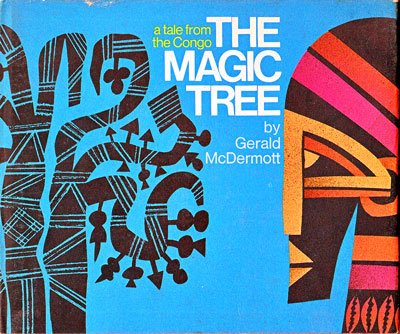
  • The Magic Tree by Gerald McDermott

    Gerald McDermott’s The Magic Tree is a not a tale with a happy ending – indeed the final pages are deliciously ambiguous.

    First told as an animated short film in 1970 and then published in book form in 1973, The Magic Tree is apparently adapted from a traditional Congolese folktale. It tells the story of two brothers, one favoured by their mother, Luemba, and the other ‘ugly’ and cast aside, Mavungu. Mavunga leaves his family home and travels down the river to where he finds a tree and frees a beautiful princess from its magic spell.

    Mavungu is transformed and a village springs up around he and the princess. Eventually Mavungu’s family hears of his fortune and travels to visit him. Mavungu feels the pull of the family home but is reminded by the princess that he has promised never to speak of the magic tree and its spell. His family leaves but Mavungu decides later to pay his despicable mother another visit and he cannot hold his tongue – all is revealed. Mavungu flees only to find that everything is gone.

    The story’s end – told entirely without words – is jarring in a way that opens up the narrative for discussion. What happens now to Mavungu? Why was his mother so wicked? Why is this so unfair? Although these are unpleasant questions, you can almost see them playing out in the little listeners minds.

    Beautifully illustrated with an almost wood-cut feel and with great use of dark blues and orange tones, the story’s atmosphere carries well. Also, I think that this book must of have been my first mass exposure to Helvetica as a child. The contrast between the jerky lines of the illustrations and the straight functionalism of the type is lovely too.

    I’d be keen to see the short animation the story was evolved from. McDermott has some of his other animations from the period freely available via the Academic Film Archive and the Internet Archive.

  • Vunce Upon A Time by Siobhan Vivian and J. Otto Seibold

    A Halloween story illustrated by J.Otto Seibold was almost certain to be a winner. Seibold is probably best known for the slightly demented digital illustrations and his Mr Lunch series. You might also know his work from Olive.

    I picked this one up at the Giant Robot store in San Francisco after a surprisingly short stop at Amoeba Records.

    In Vunce Upon A Time a vegetarian vampire called Dagmar finds his secret supplies of lollies have run out. Despairing, one of his friends, a skeleton, tells him of a human tradition called Halloween where lollies are in plentiful supply. Although the prose is rather clunky, and the story convoluted – far too little is made of Dagmar’s vegetarianism – Seibold’s garish and colourful illustrations carry the attention and interest of the young ones. There’s a fantastic double page spread where Dagmar soars high above the town on Halloween night – revealing a town swarming with a cornucopia of costumed beasts which makes for a good bit of ‘spotto’. And, in fact, the assorted lollies on the inside flap always end up being “shared” between us, the readers.