Tag: 3 and up

  • The Fantastic Flying Books of Morris Lessmore by William Joyce (Moonbot Studios)

    Hey, what’s this? An iPad App in a blog about children’s books?

    Sacrilege?!

    No, in fact The Fantastic Flying Books of Morris Lessmore is the kind of e-book both my kids and I had been waiting for. What’s more (and somewhat ironically) it itself is an ode to the pleasure of books.

    We’ve had a number of the ‘interactive books’ in the house since the iPad set foot in our abode. First the Dr Seuss titles from Oceanmedia – really just early readers with a ‘read-it-to-me’ mode. Then those interactive ‘reference titles’ like the Solar System.

    But none, until now, have really started to show the potential of the medium in terms of storytelling. No doubt Lessmore’s richness is a result of its parallel life as a short film, and the talents of Pixar-quality illustration and animation (Joyce used to do character design for Pixar). But the first thing that struck me about this title was that the interactive elements were so well integrated into the story itself. Whereas other titles intersperse a classic story with an interactive scene (Alice in Wonderland being the first example of this), every scene in Morris Lessmore is ‘interactive’ – but not to the point where it takes over from the story itself.

    Apart from the illustrations, animation and interactivity, what matters most is that it’s a worthwhile story too – a man who gets lost in books – with the same wistful quality that Pixar’s Up did.

    Being a well designed App, the sound effects, music and voiceovers can all be toggled as well as the text itself – so you can go completely ‘book-like’ or completely ‘film-like’ depending on your preferences.

    At US$4.99 The Fantastic Flying Books of Morris Lessmore is a complete bargain – you’d be paying $20 if it was a hardcover picture book. And it’d be half as fun. Highly recommended.
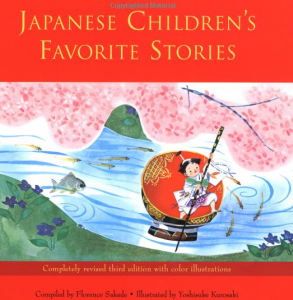
  • Japanese Children’s Favourite Stories compiled by Florence Sakade & Yoshisuke Kurosaki

    In preparation for another visit to Japan I’ve been reading the children some Japanese folk tales – as well as watching large swathes of the Studio Ghibli films, paying particular attention to the shape-changing Tokyo-dwelling racoons in the quirky Pom Poko. I probably would have introduced the awesomely weird Great Yokai War had they been a bit older.

    I was looking for some good, well illustrated, collections of stories and came across Florence Sakade & Yoshisuke Kurosaki’s Japanese Children’s Favourite Stories at a local bookshop. Originally compiled in 1953 from stories in an English-language version of a Japanese children’s magazine of the time, I bought the third edition (2007) which has lovely coloured illustrations and an audio CD of the stories for the car.

    I’ve been really impressed with the attention that these stories have managed to keep when I read them to the kids. The stories are the right length to get through a few in a night. We’re particular fans of the Why The Jellyfish Has No Bones and The Old Man Who Man Who Made Trees Blossom – both stories with absolutely horrible evil protagonists; and of course, The Rabbit In The Moon is a great short story which helps explain why the ‘rabbit is making moon cakes’ at full moon.

    Recommended.

    (And, coming back to the Great Yokai War, I’m really hoping we can pick up a copy of the Shugeru Mizaki’s Yokai Encyclopedia – but in the meantime The Obakemono Project is a fantastic online resource for the weirdest Japanese goblins!)

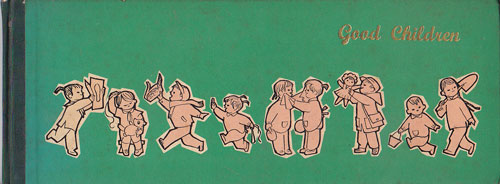
  • Good Children by Miao Yin-tang

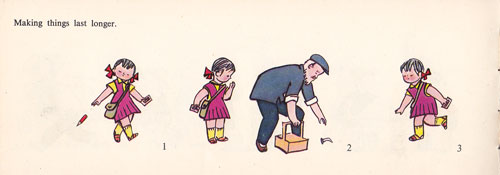
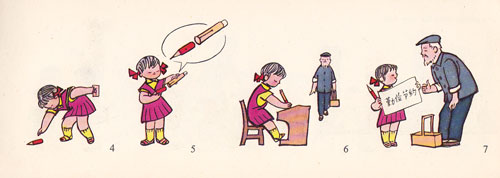
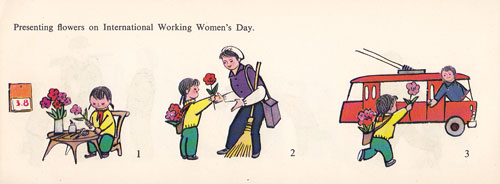
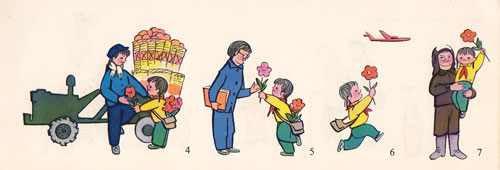
    I’m not quite sure why I ended up with this as a child. But here it is, a 1974 propaganda book from the People’s Republic of China’s Foreign Language Press.

    Essentially a pictorial guide with English text to being a ‘good child’ it offers helpful guidance on how to behave on International Working Women’s Day, and how to make the most of what you have, repairing broken toys, putting friendship first, helping old people. These are good upstanding things to do and the quaint pictures are, well, quaint. In fact, if it wasn’t for the ‘shoes for a people’s soldier’ page, this is entirely what you’d expect from a Sunday School book of the period.

    In an age where children seem to get whatever they want it is a good idea to show them that it doesn’t have to be like that, and for the vast majority of the world, it isn’t like that at all.

  • The Annotated Brothers Grimm edited by Maria Tatar

    Several months ago one of my friends was asking on Twitter about good ‘classic’ children’s books and I recommended this one as possibly the best collection of Grimm’s fairytales. I had just bought a copy and we’d started going through it as bedtime reading.

    Apart from being entirely un-Disney-fied, what is especially nice about the Tatar edited collection is that each story comes with copious sidebar annotations for the reader. These sidenotes are very useful at explaining the underlying meanings in some of the choices of words and character traits in both the very well known and lesser known stories.

    Snow White, Cinderella, Rapunzel – they are all here amongst the 37 stories for children – but the original versions with the witch who has to dance to her death in burning hot iron shoes, doves that peck the eyes out of the evil sisters – and all those sorts of violent and explicit moral guidances that have been removed from the modern popularised versions. Indeed, reading these the clear role that fairytales and myths played in educating children about the dangers of the forest, of strangers, and of life, comes across loud and clear – indeed, quite graphically.

    The king’s mother was an evil woman . . . . A year later, when the queen gave birth to her first child, the old woman took it away and smeared blood on the queen’s mouth while she was sleeping. Then she went straight to the king and accused the mother of eating the baby. [from The Six Swans]

    The contemporary sanitising of fairytales effectively eliminates the critical role of stories in allowing children to explore their own boundaries with their imaginations. Instead the sanitisation of Disney, or worse the Barbie range of Fairytopia hideousness, simply renders any sense of moral message or warning mute for the sake of shifting more branded merchandise.

    Illustrated lightly with drawings and paintings from different versions of the stories, this has been a great volume to have on hand to counter the inevitable influx of pink princess dross with a bit of grit.