Category: Books

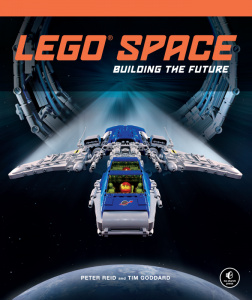
  • Lego Space: Building the Future by Peter Reid (No Starch Press)

    Lego Space Cover

    When I was a kid, two of my favourite things were my Space Lego and a book by Stewart Crowley, Spacecraft 2000 to 2100AD. Crowley’s book was notable mainly for its assortment of amazing early 1970s science fiction book cover illustrations that were repurposed/licensed to accompany Crowley’s history of the Terran Trade Authority and its space war with Alpha and Proxima Centauri. Covering different spacecraft – complete with engineering specifications – that were used to trade with and later battle, the book was the sort of thing that could quickly provide a backstory to a Space Lego build.

    But now there’s this – Peter Reid’s Lego Space: Building the Future.

    Peter Reid’s book reminds me a lot of Crowley’s, and it is done in Lego. Reid is one of those amazing ‘adult fans of Lego’ who has built an entire alternative universe of space themed Lego models and dioramas out of primarily first generation, late 70s Space Lego and the late 80s Blacktron Space Lego parts. Reid’s models are utterly amazing and show what is possible with Lego. Whilst building instructions are provided for a few of the smaller models you will probably have difficulty some of the necessary pieces, especially the all-black pieces. (I’m excited that his Exo Suit, featured in the book, made it through the Cusoo process and will be commercially available in 2014)

    Reid’s storyline follows humankind’s exploration of space from Sputnik and the Moon landing, through to first alien contact on Jupiter’s moon Ganymede. Its quite a good story for a 6 to 10 year old, far better than any of the stories in those terrible ‘official’ Lego stories (avoid the Ninjago ones like the plague!). There’s also enough filmic references, to make you, as a parent, want to sit your kids down and watch Aliens, Dark Star, 2001, and the classics. And a bonus point for the Lovecraftian allusions to the vast unknowable terrors of the universe when Admiral Kazak first brain-melds with the worm discovered in the ice. Double bonus points for including female minifigs and characters in the story – especially given the (continuing) general dearth of them in the Lego portfolio (let’s not talk about Lego Friends).

    Highly recommended.

    Some of Reid’s Lego models in his Flickr stream.

    Seb Chan
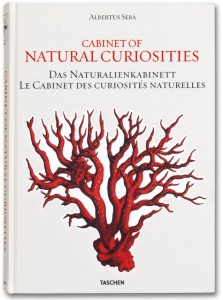
  • Albertus Seba – Cabinet of Natural Curiosities (Tashchen)

    cover_ju_25_seba_curiosities_1107131700_id_250489

    It is probably the height of aspirational middle class parenting to buy your five year old a Taschen hardcover tome but hear me out.

    Albertus Seba was an pharmacist and collector of specimens from around the globe in the early 1700s. Based in Amsterdam he amassed such an incredible collection both in breadth and depth, reknowned throughout Europe, that he commissioned artists of the time to draw illustrations of his specimens. This lead to the publication of a four volume ‘thesuarus’ of the natural world between 1734 and 1765 delayed by his death in 1735.

    Art publisher Taschen has produced this fantastic set as a single book based on a hand-coloured original with about 400 plates. The detail and diversity is amazing and my son was immediately captivated by its intricacy and strange accumulation of snakes, frogs, lizards, plants, squid, shells, insects, spiders, and butterflies.

    Excited flicking through the pages, “what is that?”, “is that really a . . ?”, “is that real?”.

    Unlike modern ‘references’ books of the natural world – littered with saturated photography and didactic text – there is an immediate sense of ‘wonder’ that pops out from Seba’s arrangements and the intricately detailed hand drawn illustrations. Much like the ‘specimen drawers’ in natural history museums that are making a comeback, there is a certain type of inspiration that comes from seeing ‘everything at once’.

    It is a lovely book and one that more children should be allowed to get their hands on.

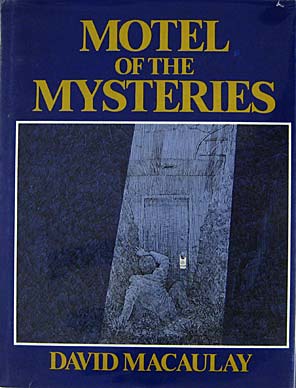
  • David Macaulay – Motel of the Mysteries

    macauley_motel_mysteries_cv

    Macaulay is probably best known for his The Way Things Work, an illustrated guide to how everyday tools and machines work that came out in the late 1980s and then was remade as a CDROM (remember them?!). Big in North America, I hadn’t come across his books until Michael Edson brought a copy of Pyramid for my kids on a speaking trip to Sydney. Apparently it was Michael’s favourite book as a kid – and was a big influence on why he ended up working in museums. Pyramid is a wonderful exploration of how the pyramids were made, their secret rooms, and architecture. Macauley’s detailed line illustrations are what makes the book, along with quirky text.

    But in fact the one that has, so far, resonated most with my kids has been Motel of the Mysteries.

    Written in 1979 it parodies the type of pop-archaeological narratives of that period- the ones that also resulted in the success of the Indiana Jones films.

    Set in the distant future of 4022, archaeologist Howard Carson uncovers an ancient tomb in USA – a cheap motel room from 1985 when a great accident occurred. Of course, knowing little of this strange civilisation, Carson ‘interprets’ these found objects in amusing ways – a toilet seat becomes a ceremonial collar, the bowl is the urn, naturally.

    ”The most holy of relics was discovered in the Inner Chamber. It was carved froma singe piece of porcelain and then highly polished. The Urn was the focal point of the burial ceremony. The ranking celebrant, kneeling before the Urn, would chant into it while water from the sacred spring flowed in to mix with sheets of sacred parchment.”

    An exhibition ensues and the latter part of the book is the ‘exhibition catalogue’.

    Its a great read – and a useful reminder of our inevitable misinterpretations of the past. My kids love the notion that we could get it so wrong in the future. The pen and ink drawings are, naturally, amazing. And if you work in or around museums, then there is that extra layer of resonance.

    Beware one of Macaulay’s other books, Underground, which takes the reader beneath a ‘typical city block’ and explores how buildings stand up and all the pipes and tunnels beneath the metropolis that supply crucial services. It is likely to make you children want to become urban explorers . . .

    Either way, you need Macaulay’s prolific work in your children’s lives.

  • Short glimpses of the future

    New York City has flooded.

    Already discussions (New York Times) are rising as to how to deal with increased flood activity and build resilent but malleable infrastructure to inhabit the lowlands in the future.

    “New York became divided between wealthy, glittering Uptown and the struggling poor who remained in drowning Downtown because they had nowhere else to go. Instead of abandoning their homes, they adapted, closing off the flooded lower floors of structures that were otherwise still habitable and starting a strange, scavenger society in what remained … [snip] … Years passed. The sunken portion of Manhattan Island evolved. People Downtown tended to ignore the northern view, just as those Uptown liked to pretend the Drowning City did not exist just beyond their reach. Uptown continued to thrive, to flower with new business and gleaming, modern architecture, while Lower Manhattan canibalized itself, cobbling together a community of canals and bridges, of dangerous shadows and rebellious minds. The Drowning City, some of its older denizens called it.” (from Joe Golem and the Drowning City)

    I’ve been reading Mike Mignola & Chrstopher Golden’s Joe Golem and the Drowning City which is set in a parallel New York where downtown has been flooded since “the great floods of the 1920s”.

    Joe Golem and the Drowning City exists in that strange world of ‘young adult fiction’ most probably because of its connection to Mignola (Hellboy etc) and comics. With a strong 14 year old girl, Molly, as the heroine, It is a fun read, pulpy and fast paced, and not at all taxing.

    It is hard to separate my mental image of the world of Molly with that of New York of the last few days – and also of Bioshock.

    Video games shape so much of children’s reality at the moment – and their imaginative play. I’m excited by the best of this and fearful of the worst.

    Just today my 8 year old daughter created a world in Minecraft and populated with a treasure hunt for her 5 year old brother’s birthday party. Staring into screens a squabble of children sat and hunted for the treasure buried deep inside a virtual cake. Whereas once we would have hidden treats around the house, the garden, and maybe the local park, today we’re doing these same activities in digital equivalents entirely of our own children’s construction. For them this is incredibly empowering – they’ve given their own imaginary worlds and dreams digital flesh. But I wonder what happens to the park – and when the park is the only malleable space available to other children.

    In my grandchildren’s time I expect that what will be malleable will be actual flesh – if we can get bio-engineering to follow the same consumerisation path that 3D printing is. And that is exciting.

  • The Element Encyclopaedia of Magical Creatures by John & Caitlin Matthews (Sterling)

    When I was growing up I used to dip in and out of Funk & Wagnall’s Dictionary of Folklore, Myth and Legends. A hefty tome bereft of images, it used to sit on the shelf beside the other dictionaries and encyclopaedias. And I always thought Funk was a cool surname, even when one of my high school science teachers was also called Mr Funk.

    I popped into Strand Books today with the children in tow, giving them an opportunity to spend their pocket money on something other than sweets laced with high fructose corn syrup. And there sitting amongst a frightfully small ‘mythology’ section, was this – The Element Encyclopaedia of Magical Creatures.

    I am bit surprised that there aren’t more of these sorts of books around – especially in the wake of Harry Potter and the recent wave of teenage pulp undead fiction. Of course, there’s a lot of single species books designed to look like ‘faux-olde-worlde’ tomes with puffy covers (the -Ology series) or cheaply produced paperbacks full of badly Photoshopped stills from recent movies. But there’s certainly not the wealth of well-illustrated hardcovers that I had as a kid.

    Anyway, back to The Element Encyclopaedia of Magical Creatures.

    Pitched at upper-primary readers and beyond, I was pretty impressed by the diversity of creatures contained within, and their histories. There’s plenty of global beasts drawn from lesser known mythos, as well as the obvious choices. Some woodcuts keep the illustrations appropriately restrained, no 12 year old’s fantasy fiction drawings in this one fortunately. On the downside, it would have been good to have had a bibliography with at least a few of the entries for further mythological investigations.

    Nevertheless it is a good go-to-book anytime you get asked “Dad, why is the basilisk in Harry Potter different to the basilisks in other stories?”.

  • Kid Koala – Space Cadet (UNI Books)

    Eric San/Kid Koala’s Space Cadet is his second illustrated book – and, like the first, Nufonia Must Fall, comes accompanied by a soundtrack CD – that is meant to be played whilst the book is read. The story of a guardian robot and a young girl who grows up and becomes an ‘extraterrestrial botanist’, Space Cadet is told entirely without words. Although the story flips between the two main characters and the present and the past without the more obvious comic book traits, it is very easy for children to follow and become engrossed in.

    The musical accompaniment is fantastic also – although to read it at the pace of the music (roughly half an hour) would require at least three times the length of story. Composed by Kid Koala with turntables and a piano, it keeps the turntabilism to a minimum, whilst recalling the contemporary classical work of Max Richter and the slightly off-kilter atmospherics of The Caretaker/Leyland Kirby.

    Poignant without being overly sentimental – it made both my children cry – the whole package comes highly recommended. As an added bonus, for regular readers who have girls, it is great to have another story of a successful scientist who is a girl!

    You can buy it direct from Kid Koala. So, what are you waiting for?!

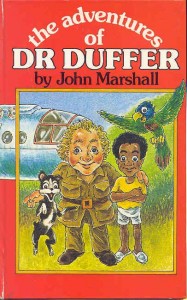
  • The Adventures of Doctor Duffer by John Marshall

    As you may now know, I’m in the midst of moving to New York. And with this has come the necessary cleaning out of books.

    Many from my own childhood have gone to new homes where they’ll be appreciated by children other than my own. But I have kept a select stash of my own which are being shipped to a future tiny apartment somewhere in Manhattan.

    One that is coming with us, and that I’ve just started reading to my vehicle-obsessed son, is The Adventures of Doctor Duffer.

    Written by a former prime minister of New Zealand (my copy signed even!), Doctor Duffer is a quaint story of adventures with a smart parrot with a ‘West Indian accent’, a trusty terrier, and a Polynesian boy who accompany the Doctor as he travels the world. The best thing about the series is the Aeronaut, Duffer’s vessel that can fly, sail, drive and even dive underwater. It is an easy hook and even though some of the adventures themselves show their age (the stories were written by Marshall when he was a student in the late 1930s), they also capture a particular New Zealand-ness which I hope will be useful when my kids struggle to distinguish ‘colour’ from ‘color’.

    Come to think of it, the Aeronaut was probably why I also have kept Jan Wahl’s SOS Bobomobile to read. But that will be another post.

    Another useless fact. I’ve actually got another book from a New Zealand Prime Minister. Geoffrey Palmer gave my daughter her first copy of Hairy Maclary from Donaldson’s Dairy shortly after she was born!

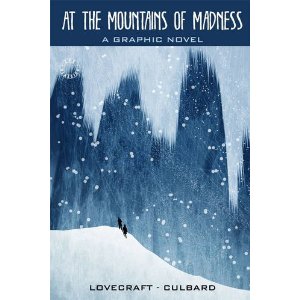
  • At The Mountains of Madness: A Graphic Novel – HP Lovecraft & INJ Culbard (Self Made Hero Press)

    I was in lower secondary school when I came across HP Lovecraft and I remember raiding the local public library for several months, trying to read every possible story and associated work. They weren’t popular titles at the library and I got onto other writers like Ambrose Bierce and August Derleth as I went on. Pulp was good for the teenage imagination – and the historical atmospheres had far more resonance with me than a lot of contemporary pulp of the 80s.

    It wasn’t until many years later in the mid 1990s that I realised that I wasn’t alone in my interest in Lovecraft – and as it turned out the whole Cthulhu mythos is deeply ingrained in much of nerd culture.

    As part of Self Made Hero’s series of INJ Culbard’s re-visioning of genre classics (notably several Sherlock Holmes titles), comes one of my favourite Lovecraft stories – At The Mountains Of Madness.

    Set in Antarctica in 1930, a group of explorers discover remnants of an ancient civilisation beyond the ice . . . It is a great short story and in graphic novel form it works particularly well, simultaneously prizing open the difficulties of the archaic-ness of much of Lovecraft’s writing style, and emphasising the pace and oddness of the original. The way in which the story unfolds graphically is done beautifully with fantastic angles and frames whilst also paying homage to Tintin’s classic adventure comic visual style.

    This isn’t one for small children – but for younger teens it is a great introduction to one of the more interesting pulp writers of the early 20th century whose alternative universes are well worth exploration, especially for those with an interest in speculative science. The graphic novel form is a much easier proposition that Lovecraft’s dense text and should whet the appetite for the other stories related to the Cthulhu mythos.

    You can buy direct from Self Made Hero Press.

    Bonus: the original short story was the basis of one of my favourite 1980s horror films – John Carpenter’s version of The Thing (1982). I even did a live remix of the soundtrack at the club night I used to run in Sydney. Carpenter’s film was billed as a remake of the 50s classic The Thing, but in many ways it is truer to Lovecraft’s short story combining it with elements of Alien.

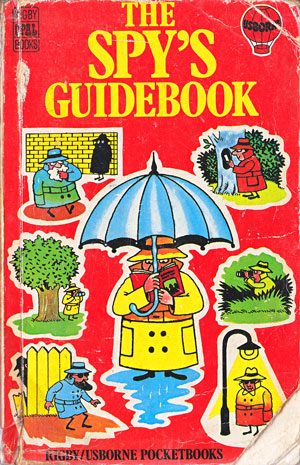
  • The Spy’s Guidebook (Usborne)

    Yesterday I was invited to give a public talk about one of the books that inspired me from the distant past. I had to decline the offer because of the timing but it got me thinking about what that book might be.

    Rummaging around my old children’s books I managed to find the one.

    Usborne’s The Spy’s Guidebook.

    I loved this book as a kid. I must have read it hundreds of times – and for some reason I have two copies. One quite battered and loved to death, and the other in much better condition. Opening it after all these years brought back a flood of memories.

    The Spy’s Guidebook was, I think, three single titles in a series compiled into one thick volume.

    (As an aside, there was another ‘detective’-oriented series – one volume of which, Catching Crooks, I managed to leave with my teddy in a bag by the side of the road on a trip to Canberra one school holidays. I was distraught and I remember, when we got home, my mum and dad vainly calling the police to see if it had been handed in. Being the 70s, it had and a few days later there was a amusing puff piece in the Daily Telegraph about the police finding my bag with Catching Crooks in it. I really should find and scan that clipping)

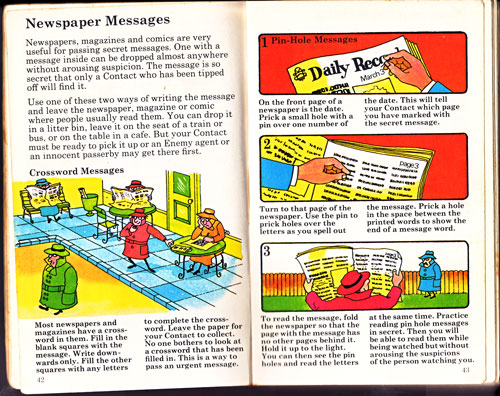
    But back to the Spy’s Guidebook. As a kid this book was like stepping into a world where the walk between your house and your best friends’ houses was filled with danger and, of course, many opportunities to try out the stealthy tricks from the book. We’d make secret code wheels, write messages in invisible ink, try to move without being noticed. The quirky illustrations and raincoated spies, straight out of Spy vs Spy, help make the book so approachable and engaging.

    I don’t buy the idea that this sort of ‘childhood secret club‘ behaviour has disappeared with the omnipresence of portable games and digital intrusions or squeezed out by the revoting concept of ‘tweens’. Some of this ‘secret club’ behaviour has just migrated to the web and to these communication devices themselves – I wish I’d had a iPod Touch or DS as a kid – we could have done some awesome codebreaking and crazy adventuring with them! And I’m always amazed by the imaginative worlds even the most cotton-wooled kid manages to conjure up out of the most meagre of raw materials. You see this happening with kids at the park everyday – if you look.

    It seems that the Spy’s Guidebook is still in print although apparently it was revised in the 1990s when it came with a CDROM (!!). But I’m pleased I have a late 19070s copy to pass on to my kids and I hope they get as much from it as I did. If you see a copy in a secondhand store, grab it. It really is an excellent read.

  • Yokai Attack! The Japanese Monster Survival Guide by Hiroko Yoda & Matt Alt (Kodansha)

    Last time I wrote I was heading off to Japan for the school holidays. We survived that trip with the help of this handy and fun little guide. We even managed to spot some of the monsters contained within along the way!

    Yokai Attack! is the kind of book that as a 9 or 10 year old I would have pored over for months.

    Short, written in a ‘vital statistics’ style, and for those who just want to dip in and out from time to time, it details roughly 40 strange Japanese monsters, or more accurately, ‘spirits’. Some of these are from traditional folklore like Onibaba, the mad old woman who ate her daughter and grandchild, and the Kappa, the cucumber-obsessed flatulent amphibian that drags unsuspecting people under in Japan’s waterways (and after whom cucumber sushi rolls – kappa-make are named!). While others are better known from Manga and Japanese horror films.

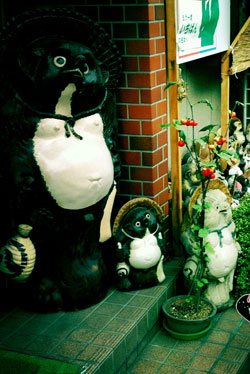
    If you’ve watched Miyazaki’s wonderful animations Spirited Away, My Neighbour Totoro or Pom Poko, then you will know a fair number of these creatures already – which is why this book is equally fun reading for young and old. Spirited Away features, amongst other spirits, a Nopperabo (“no face”) who visits the bathhouse and Pom Poko is all about the antics of the Tanuki, the magical Japanese racoon dogs with unfeasibly large testicles (!) who play shapeshifting tricks on humans and like to party and drink themselves into a stupor. My children had great fun pointing out the Tanuki statues we saw outside of noodle bars in Kyoto, Osaka and Tokyo!

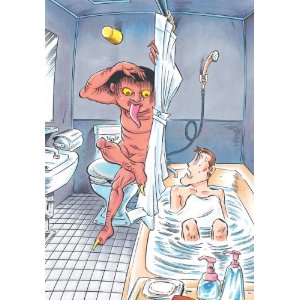
    The book is illustrated by Tatsuya Morino with amusing cartoons of each monster. Here’s the bath dwelling Akaname. This one uses its tongue to attack and clean all those who bathe in dirty bathrooms . . . .

    For younger children these monster stories need adult supervision. Quite a number are creepy in a Japanese horror movie kind of way. But if you are planning a visit to Japan with children then I’d highly recommend it as it provides many new ways to view the many odd things your children will encounter and ask about (even if your only questions relate to the omnipresent Tanuki statues).

    Similarly if your children are fans of Miyazaki’s films the book offers an additional layer of interpretation, pitched just right for their attention span and curiosity.

  • Japanese Children’s Favourite Stories compiled by Florence Sakade & Yoshisuke Kurosaki

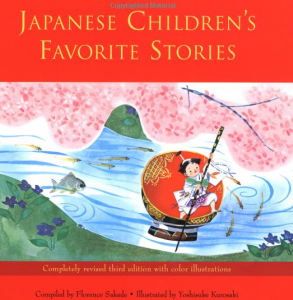
    In preparation for another visit to Japan I’ve been reading the children some Japanese folk tales – as well as watching large swathes of the Studio Ghibli films, paying particular attention to the shape-changing Tokyo-dwelling racoons in the quirky Pom Poko. I probably would have introduced the awesomely weird Great Yokai War had they been a bit older.

    I was looking for some good, well illustrated, collections of stories and came across Florence Sakade & Yoshisuke Kurosaki’s Japanese Children’s Favourite Stories at a local bookshop. Originally compiled in 1953 from stories in an English-language version of a Japanese children’s magazine of the time, I bought the third edition (2007) which has lovely coloured illustrations and an audio CD of the stories for the car.

    I’ve been really impressed with the attention that these stories have managed to keep when I read them to the kids. The stories are the right length to get through a few in a night. We’re particular fans of the Why The Jellyfish Has No Bones and The Old Man Who Man Who Made Trees Blossom – both stories with absolutely horrible evil protagonists; and of course, The Rabbit In The Moon is a great short story which helps explain why the ‘rabbit is making moon cakes’ at full moon.

    Recommended.

    (And, coming back to the Great Yokai War, I’m really hoping we can pick up a copy of the Shugeru Mizaki’s Yokai Encyclopedia – but in the meantime The Obakemono Project is a fantastic online resource for the weirdest Japanese goblins!)

  • Ramayana: Divine Loophole by Sanjay Patel

    I’ve never read the Ramayana nor really delved deep into Indian mythos. Brought up on the Greco-Roman and Chinese pantheons, the only other mythos I really explored intently as a child were Egyptian (no child can really resist pyramids?) and Norse (Thor! Loki!).

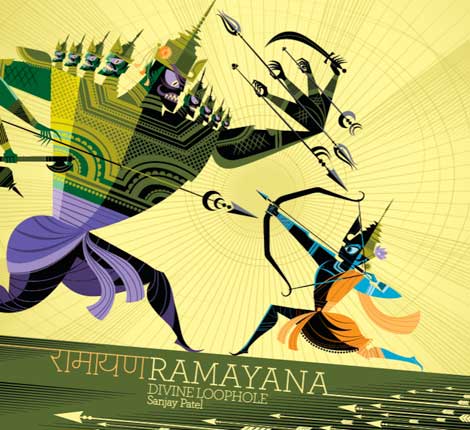
    However tonight I read my youngest the first half of Sanjay Patel’s seriously abridged Ramayana (24,000 verses condensed to 107 pages!).

    Patel is probably best known to those in the illustration and design world as one of the Pixar animation team. And here in Ramayana: Divine Loophole he tells the general story through vibrant illustration and some not-quite-so-vibrant text.

    I really can’t fault the digital illustrations. They are stunning and stylised to capture immediate attention – indeed, they reminded me most of the style of The Incredibles – one of the Pixar titles on which Patel worked. The demons are menacing and fierce without being terrifying, and the colour palette is completely saturated, vibrant. The heroes bright and bold. (Check out Patel’s site Ghee Happy for some spreads from the book.)

    The text, for the most part, is functional. But there are some clunkers. I’m not a fan of unnecessary colloquialisms like this – “But [Soorpanaka] was love struck, so much so that she transformed herself into a beautiful maiden and tried making a pass at the blue prince by showing off some of her dance moves”. They end up cheapening the story. Fortunately there aren’t too many instances of these.

    Slightly problematic, at times, too is the contrast on the text. With almost edge to edge illustrations there are a quite a few pages where the small point text vanishes. The worst offenders being the pages with pale yellow text on an orange background (ugh!). I almost unintentionally skipped those paragraphs!

    The final third of the volume, after the main story, is a collection of key characters, gods and demons; a map of the story locations; and several pages of process sketches.

  • When should children start on graphic novels & comics?

    When should children start on graphic novels & comics? Well there’s a question.

    I can’t remember when I started reading comics.

    It was some time in the early years of primary school. And I can only really remember that because I got in trouble for running a comic lending business which lasted all of a few weeks. Somehow I found a stash of cheap Richie Rich and Caspar comics in this newsagent a little past my school in Balmain and I bought up a pile of them.

    For some reason they had some kind of magnetic pull. Given the narratives were so terrible, perhaps it was the weird black & white advertisements for sea monkeys or that the lame stories that were completely foreign to my experience of the world to that point (largely a result of only being allowed to watch the ABC TV, the public broadcaster, and no commercial channels).

    They were also very cheap.

    And I figured being cheap I could, with the help of one of the more maligned characters of the class acting as ‘enforcer’, bring a bag of comics to school and ‘rent’ them out for a few cents a day.

    I can’t quite remember how this little bit of capitalist entrepreneurialism came to an end, only that it did. One day I had my two foot-high of comics confiscated from my desk and then it was over. I seem to remember, too, that one of my friends – totally out of character – ‘borrowed’ one of the comics for an ‘extended period’.

    Around the same time I devoured the entire Tintin series in a fortnight – as fast as I could get them all out of the library with borrowing limits – and it wasn’t until the subcultural legitimation of ‘graphic novels’ in the late 80s, early 90s that I got back into an occasional read. And of course, when I was in Brussels in the late 90s I made sure I visited the Musée Hergé.

    So, given my experience of comics wasn’t grounded in any kind of parental encouragement – in fact the opposite (it was ‘proper books’ only) – when is the right time to start introducing Tintin and other comics into the reading pool?

  • A Book of Ghosts & Goblins collected by Ruth Manning-Sanders

    I’m not quite sure when it is ‘appropriate’ to introduce ghost stories to children but I reckon if there are tooth fairies who exchange money for enamel and calcium, and trolls that might leave treats under the bed, then there must also be less savoury magical creatures too.

    In the late 60s and early 70s Ruth Manning-Sanders published a great series of fairy tales from around the world in volumes organised by the creatures present. This one, A Book of Ghosts & Goblins, is one of the best in the series with some quite scary short stories for children.

    I was reading the short Spanish story The Ring to my 6 year old and it brought back vivid memories of hearing it the first time as a child myself. A man finds a ring on an unearthed skeleton in a disturbed graveyard and gives it as a present to his wife. Then that night the ring’s owner comes back to claim it . . .

    There’s some great Estonian stories of nasty goblins as well as some enjoyable African and Siberian contributions too.

    Try to find a copy in your local public library.

  • Good Children by Miao Yin-tang

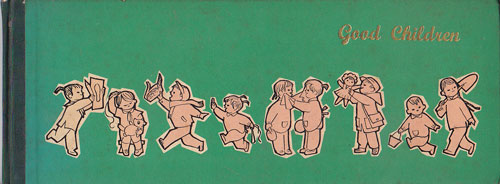
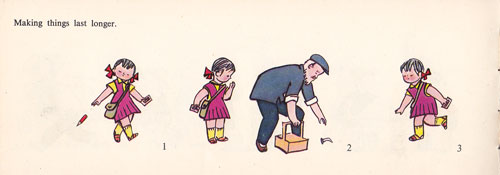
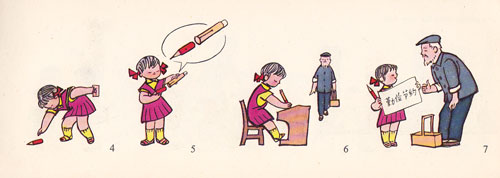
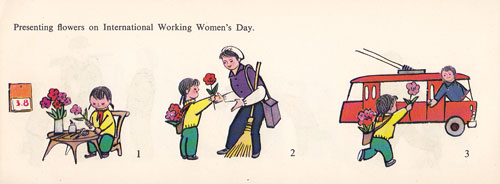
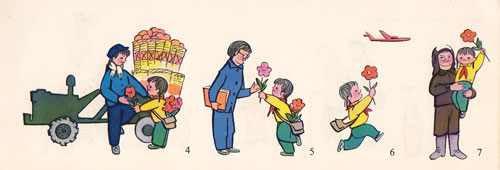
    I’m not quite sure why I ended up with this as a child. But here it is, a 1974 propaganda book from the People’s Republic of China’s Foreign Language Press.

    Essentially a pictorial guide with English text to being a ‘good child’ it offers helpful guidance on how to behave on International Working Women’s Day, and how to make the most of what you have, repairing broken toys, putting friendship first, helping old people. These are good upstanding things to do and the quaint pictures are, well, quaint. In fact, if it wasn’t for the ‘shoes for a people’s soldier’ page, this is entirely what you’d expect from a Sunday School book of the period.

    In an age where children seem to get whatever they want it is a good idea to show them that it doesn’t have to be like that, and for the vast majority of the world, it isn’t like that at all.